
The offer sounds tempting: "Some money will land in your account, you send it on to another account and keep a percentage." But letting someone use your UK bank account can draw you into bank investigations and a criminal case, even if the money was never yours. For Iranians who already have to think about moving money and proving where it came from, understanding this risk is essential. If you are new to the British banking system, our articles on UK bank accounts are a useful starting point.
What is a money mule, and how does it relate to renting out an account?
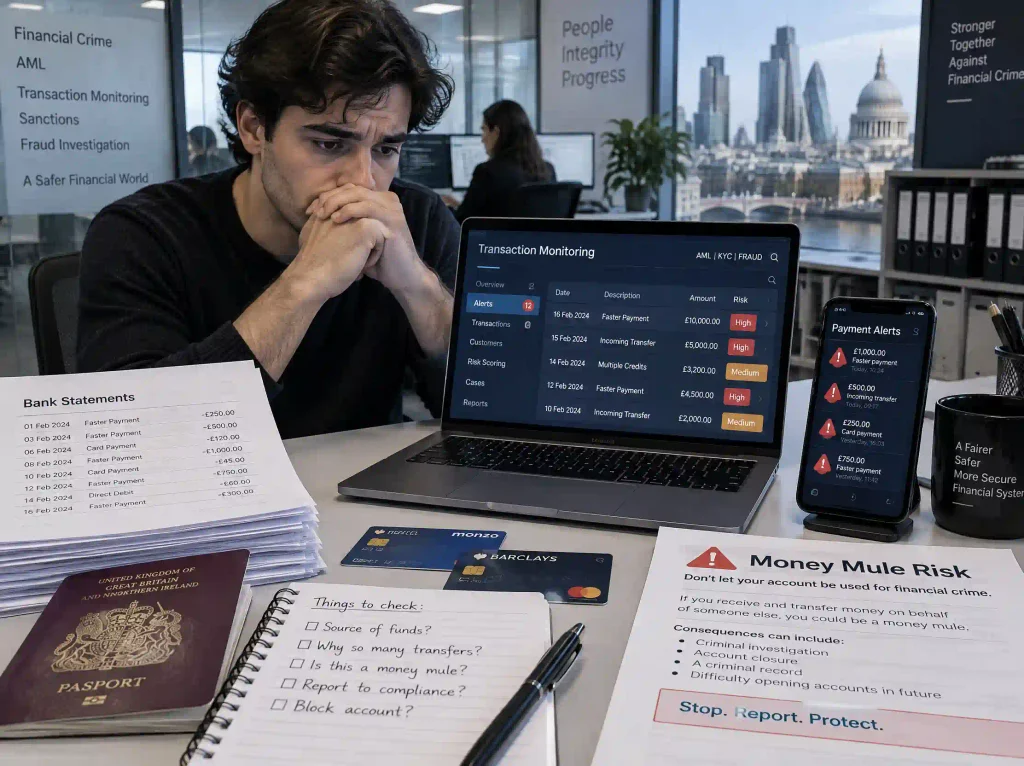
A money mule is someone whose bank account is used to receive and move money belonging to other people, money that may come from fraud or other crime. Sometimes the person knows where the money comes from, but in many cases they are drawn in by a promised fee, a part-time "job" or a request to help an acquaintance.
The fact that the account is in your name does not convince a bank or the authorities that the transactions were fine. When money arrives in your account and is immediately sent to another one, you may be asked to explain who the sender and recipient are, why the payment was made and where the money came from.

What does an offer to rent your account usually look like?
Requests don't always say "rent me your account". Someone might say they can't receive their own money for now because of banking restrictions, or a job advert might ask you to forward payments you receive to other accounts. Requests to withdraw cash, buy cryptocurrency with the money, or hand over your passcode and banking app access are also serious warning signs.
| Situation | Warning sign | Safe response |
|---|---|---|
| Money from a stranger | No clear reason for the payment | Don't move the money; call your bank |
| A fee for urgent forwarding | Money of unknown origin goes to another account | Turn the offer down |
| A request for your passcode or app access | You lose control of your account | Never share any login details |
Even if the person asking is a friend or relative, a personal relationship is no substitute for a credible explanation of the transaction.
What is the penalty for being a money mule in the UK?
In the UK, certain behaviour involving receiving, holding or transferring the proceeds of crime can fall under sections 327 to 329 of the Proceeds of Crime Act 2002. On conviction in the appropriate court, these offences can carry up to 14 years' imprisonment, an unlimited fine, or both.
That figure is not an automatic penalty for every bank transfer. The outcome of each case depends on the person's conduct, the evidence, what they knew or suspected about the criminal origin of the money, and other legal circumstances. Even so, thinking "the money wasn't mine, so I'm not responsible" can be very costly. Before accepting any unusual financial offer, compare it with a transparent money transfer.
Banking consequences, even before a court case
A criminal case is not the only worry. To investigate suspicious transactions, a bank may restrict access to your account, ask for evidence about payments, or decide under its regulations and terms whether to keep you as a customer. That can make it hard to pay rent, receive your salary or cover day-to-day costs.
Letting someone use your account can also cause problems in future when you apply for financial services. So a small fee should never be weighed lightly against the risk to your account and your financial reputation.
Why is this more sensitive for Iranians?
A link to Iran does not, on its own, make a transaction illegal. However, if sanctioned people or entities, applicable UK restrictions, or incomplete information about the sender and source of funds are involved, the matter can go well beyond a routine bank check.
For example, saying "it's my family's money" is not enough to explain a payment route; you may need evidence of the source of funds, the purpose of the transfer and the identity of both parties. In that situation, using someone else's account to avoid the bank's questions is not a solution and can make the risk worse. Understanding source of funds and financial documents helps you choose a route you can explain from the start.
If you've already accepted the offer, what now?
If no transaction has happened yet, don't give anyone access to your account or banking details, and turn the offer down. If money has already arrived or you have made a transfer, don't make any further payments, even if the other person pressures you to return or move the money urgently.
Contact your bank as soon as possible and explain exactly what happened. Keep messages, receipts, account numbers and conversation details, and don't delete anything. Depending on the circumstances, reporting the matter to the police or the relevant authority and getting advice from a solicitor experienced in financial crime may also be necessary. If you have shared your banking login, tell your bank straight away so it can help you secure the account.
What is the safe alternative for moving money?
If you genuinely want to help move family money or make a legitimate payment, do it in the name of the real owner of the funds and through a suitable, authorised financial services provider. Before transferring, ask about identity documents, source of funds, the destination and any likely restrictions. No reputable provider should ever ask you to hand your personal account to someone else to hide who is involved.
Reading about currency exchange and banking services can help you ask the right questions before any payment, but each specific transaction needs to be reviewed on its own facts.
Summary
Renting out your account is not an easy way to earn money or help with transfers. If the origin and destination of the funds are unclear, you may face bank restrictions, a money laundering investigation and, where relevant, sanctions risk. The best approach is never to let others use your personal account, and to choose a transparent route for legitimate payments from the outset.
To review your options for transferring money and the documents required, contact Sarafi Bartar London, the trading name of London-registered Primores Group Ltd and a payment services agent of Persici Financial Services Limited. Share the details of your transaction before any payment so that we can check whether we can help and what is required.
Frequently asked questions
Is receiving money in my account and sending it to a friend always a crime?
No. Making a transfer is not, on its own, a crime. But if the origin or purpose of the money is unclear, especially when you are paid a fee for moving it, clarify the situation before you do anything.
If I didn't know the money was suspicious, can I still get into trouble?
Yes. The bank may investigate the transaction and restrict your account. Criminal liability also depends on the evidence and circumstances, including what you knew or suspected.
If suspicious money lands in my account, should I send it straight back?
Don't move the money on your own. Tell your bank first and follow its instructions.